Claude Cahun, propaganda, in training
My mother, now retired, was a public school librarian. This provided a formative political lesson when I was young. She operated her library like all libraries, as a site of mutual aid, creative expression, and free education. She organized fundraisers, taped poems inside the bathroom stalls around the high school, and the big banner over the library doors read “Have you helped or hurt today?”
Much of this is still really the whole game to me. Getting a little group together to make a zine, or hosting a film club and a chat about history after. Free food, recycled objects, accessible public spaces. Especially when these things are organized by transsexuals and gay people and outside of capitalist frameworks, I can’t get enough of it. In the face of the (rapidly collapsing) Trumpists, I feel only more certain that this type of activity is where I want to devote my energy.
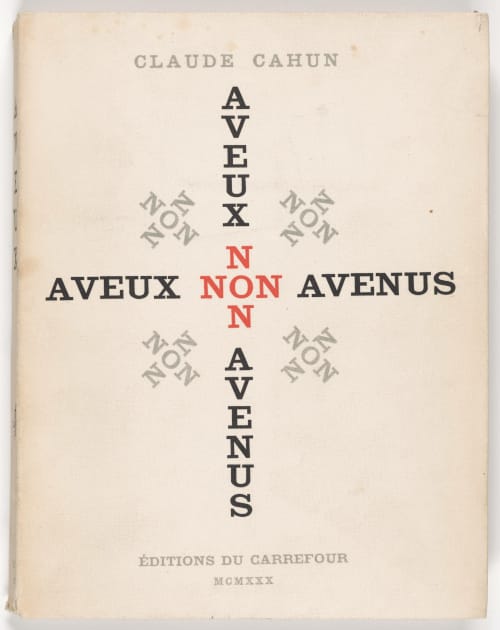
I was thinking about all of this when I read Susan de Muth’s 2008 translation of Claude Cahun’s Aveux non Avenus, called Disavowals or Canceled Confessions in English. Cahun, a French writer and artist, was an icon of making some weird gay art and then aiming it as an actual weapon at the fascists.
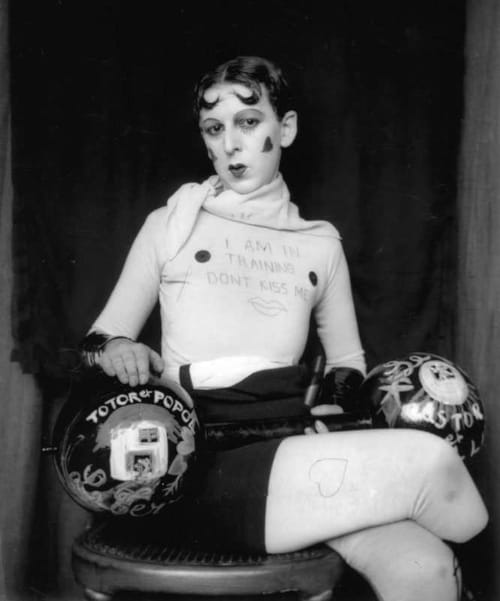
Disavowals or Canceled Confessions is a radical trans anti-autobiography, art book, and writing experiment that Cahun published in 1930. Fourteen years later, he and his partner and collaborator, Marcel Moore, were taken into Nazi custody and sentenced to death for a daring anti-fascist propaganda campaign they conducted under occupation. They survived only because Hitler’s regime fell before the sentence could be carried out.
Claude Cahun is the writer’s publishing name and androgyne alter ego. In daily life, she went by Lucy Schwob, as she was called by her romantic partner, Suzanne Malherbe, that constant collaborator who made work as Marcel Moore. Disavowals, which is rich with collage photography as well as writing, is made in collaboration with Moore, as was nearly all Cahun’s work. The text, however, is an anti-autobiography of Cahun himself, just as he makes up the subject of most collages. In a disjuncture of prose and scattered poetry, he plumbs the depths of his body and of his transsexuality, his disability, his Jewishness. He looks in broken, convex mirrors, and finds fleeting parables and poems.
Surround and then surprise the miracle. May sulking, renunciation, fasting, serve to simplify my surroundings.
I close my eyes to put a limit on the orgy. There is too much of everything. I keep quiet. I hold my breath. I lie down, curled up, abandoning the confines of my body, I fold myself in on an imaginary centre…
Already as a child I was playing this game of being an invalid: It will be easier if I hop. Sharing out the cake while cutting my bit up again. If a cube doesn’t fit into my construction, I withhold it. One by one I remove them all.
This is not without an ulterior motive… I shave my head, wrench out my teeth, my breasts– anything that is embarrassing or annoying to look at– stomach, ovaries, the brain, conscious and covered in cysts. When I have but one card left in my hand, just one heartbeat to notice, but to perfection, of course I will win the trick.
Post mortem. – No. Even then, reduced to nothing, I would understand none of it. No more. Who cannot swallow it all cannot swallow the tiniest bit of it.
That’s from the second chapter, “MYSELF (For want of anything better).” Cahun’s writing always makes me think of Kate Zambreno and their work, some of which directly engages his.
Following some years in Paris’s radical arts scene, and after the publication of Disavowals and its lackluster reception among their peers, Cahun and Moore retreated to a small estate on one of the English Channel Islands, in part to seek health. With a family inheritance, they settled down on Jersey and established themselves, remaining as always very much in love. Soon after, the war began, and the Nazis occupied the island. For the next five years, Cahun and Moore lived under Nazi occupation. The fascists fortified the strategically important island, stationed soldiers there, and built work camps that they filled with prisoners from Ukraine, Russia, and North Africa. Rations thinned, the occupying force banned radios, and surveillance grew steadily.
All the while, Cahun and Moore created strange anti-Nazi propaganda that they slipped into the pockets of soldiers, tucked into German language newspapers, and left scattered at the cafes. Similar to their other art, this propaganda often combined lyric and dramatic text with illustrations and collage. They invented a mutiny within the ranks of soldiers, fabricated codes, declared times and meeting places for the rebellion. They made use of different papers, contraband typewriters, and varied styles for discrete projects, and kept their operation secret even when Nazi troops took up residence in their house. They broke into a building housing soldiers and replaced some hanging art with a photograph collage that, only when examined closely, could be seen to be making fun of Hitler. They secreted food and other supplies to the people in the work camps, and they sheltered those who escaped, as did their neighbors.
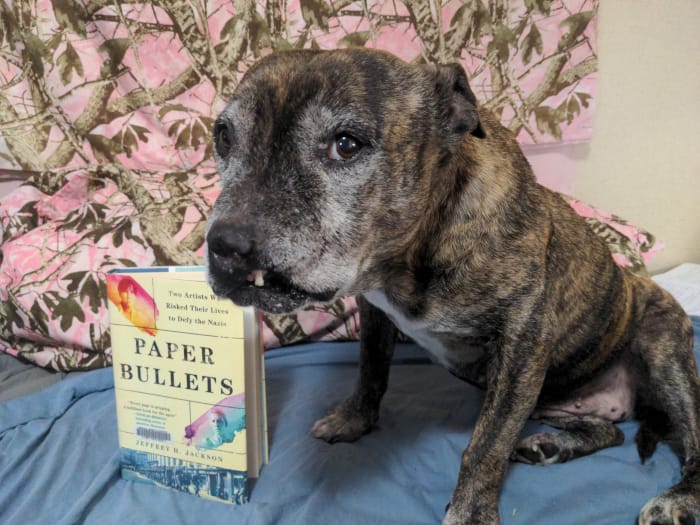
I learned the story of these years in Jeffrey H. Jackson’s Paper Bullets: Two Artists Who Risked Their Lives to Defy the Nazis. It is a great read, and the book provides a close look at the writing and art that survives from those campaigns as well as that which Cahun and Moore made while in the Nazi prisons, where they were held for months. “In the white cell / It’s the eternal Sunday / Where Monday / Never breaks the boredom,” Cahun wrote with a contraband pencil. They both maintained their wit, their resolve, and their practice of creativity throughout the long ordeal. Beautifully, they refused until the end to stop writing, to stop sharing food with fellow prisoners, just as they refused to sign a plea for clemency from the Nazis, despite that signing would have saved them from execution.
Here are a few of their countless propaganda notes, as quoted and translated in Paper Bullets:
HITLER leads us…
GOEBBELS speaks for us…
GORING gorges himself for us…
LEY drinks for us…
HIMMLER?… Himmler murders for us…
But nobody dies for us!
and
VICTORY and STRUGGLE, STRUGGLE, struggle, STRUGGLE,
STRUGGLE, STRUGGLE, STRUGGLE, STRUGGLE,
STRUGGLE, STRUGGLE, STRUGGLE, STRUGGLE,
STRUGGLE, STRUGGLE, STRUGGLE, STRUGGLE,
STRUGGLESTRUGGLESTRUGGLESTRUGGLESTRUGGLE
STRUGGLESTRUGGLEANDSTRUGGLEand pff, ppfff, pff.
and
--So, have we lost the war?
--Certainly.
--But you are happy about it?
--Most certainly.
--I don’t understand that. Why?
--Because I do not wish to squander my entire life in uniform!
Thus spoke the Soldier with No Name
Thus spoke Zarathustra!
000000000000000000000000
please distribute
The propaganda is often laced with puns, split through with clever reversals of patriotic German songs, operating on logic, humor, compassion, story, and emotion all at once. And in all of them, the spirit of Cahun and Moore persists, laughing and calling out to something greater in humanity’s complications.
This political work is so close in style and substance to Disavowals, the projects seem to bleed into each other as I read them, although the circumstances of their writing and distribution are remarkably different. Like the notes, the autobiography is flirtatious and confrontational, and it creates in its episodic text a sort of conspiracy with the reader. “GET RID OF GOD I REMAIN” it declares toward the end. There is no passive act of reception possible, only an entanglement with the writer. As with the propaganda, it is a shot in the void, intended to provoke. Cahun kept a writing practice throughout his adult life, but only a very small amount of work has made it into English, primarily Disavowals. He is better known today for the photography and collages he created with Moore.
Gender Confusion
Politics and the erotic are reduced to the vocabulary of libertinage. Here are our relaxed jacks-of-all-trades: happy to discredit at one and the same time the good actions of bosses, their efforts towards conciliation, and the kiss on the mouth. Break it up, gentlemen, break it up!
The Nazis famously destroyed archives of trans history, culture, and medical research, as well as executing many gay and trans people. Cahun’s creative acts continue during that period of incredible danger and suppression, even during his incarceration and as the fascists raided his home and destroyed much of his and Moore’s collection of art and books. His writing changes to face the circumstances head-on, but his styles and voice play across the years–a unique series of work that defies boundaries of form, audience, and authorship.
Cahun and Moore were willing to die for this, yet they wondered often what impact their propaganda might have, if any. As Paper Bullets shows, however, their little bits of scrap paper with weird gay poems demanded significant attention from the Nazi officers and wasted much time. Their campaign contributed also to a general depression of Nazi spirits, miserable distrust and unease among the ranks on the Channel Islands. And even once captured, Lucy Schwob and Suzanne Malherbe confounded the fascists, remaining defiant over days and days of interrogation, relentlessly arguing with the intelligence officers who believed the two could never have accomplished all of this on their own.
Likewise, the artists questioned the impact of the art they created in Paris. Disavowals, like much great trans literature, still hasn’t been widely recognized. It is a strange book, although light and playful, even when it has gone the furthest into its own moribund despair. In form and content, it operates on levels that Cahun’s modernist peers never achieved, a reckoning with conscious thought that leaves nowhere to hide. As a gay and transsexual experiment in autobiography, an attempt to capture in language something of our life, Cahun’s work stands as an early engagement with questions that occupy trans writers and artists through the present day. These qualities distinguish Disavowals and also contribute to its lack of wider recognition. This is a real shame, as the book is a fabulous piece of writing that rewards repeated engagement, and wider discussions of modernist literature and art would benefit greatly were they to recognize and reckon with its accomplishments.
We should never let stand the fascist lie that we have no history. They know that transsexuals and weird gay people have revolutionary histories, which is why they work so hard to erase us. But even in the most dire of circumstances, we insist that we are here.
Dear Strangers, keep your distance: I have only you in the world.
‘And me? What about me?…’ someone shouts: myself.
My beautiful future, the unhoped for reserve, comes to me. Present already past, you who evade me, one moment more respite…
Provided that it’s not too late.
We live in an urgent time. We have crossed into a sci-fi future, its nature unclear, although it is evident that the world has changed, and that new systems take shape. But as the history of the modern world shows, this is nearly always the case! It is a comfort to me that ongoing human practices remain powerful and needed—that, in fact, the urgency demands our little gay art.
&c
The War Resisters League provides an easy contemporary model for counter-recruitment campaigns. Check out some of their resources here.
One of my first encounters with Cahun came through Nathanaël, whose 2009 Absence Where As takes his work as a central subject. Truly, Nathanaël’s publisher, Nightboat Books, has been committed to some of the best transsexual writing for years. I’m so grateful for everything this press puts out.
In her retirement, my mother has more time to devote to her own reading. She has been learning lately about Argentina and the Dirty War, and about Las Abuelas de Plaza de Mayo. One recent morning, she read to me an excerpt from A Flower Traveled in My Blood where the grandmothers surround a junta officer in a plaza and hoist him in the air. When she got to the part where one of the women grabs the solider by the balls, she laughed out loud, appreciating the bravery and bold humor.
I am not so brave as Cahun or the grandmothers, but try to challenge myself. Last week, as I printed some resources on police surveillance for comrades, I again reflected on the risks we face, and where they seem to be today. The Trumpists have declared a new terrorism classification for antifa and anarchist actions, so I print more copies, and put a poem in the hands of friends as they leave my house, and resolve to never stop at least doing what I know how to do.