John Rechy, police states, Mistery

Thanks for reading my newsletter! Please share with your friends!
Recently, I had the joy of welcoming a friend home from incarceration. Doing this is for me a time of relief and also a bracing confrontation with the police state, both as it exists in prisons and as it extends across the rest of society. Previously incarcerated people are denied many of their basic rights, subjected to heightened surveillance, and forced to overcome cruel and constant barricades in order to access public life. In my state, the prisons release people and provide them only a stack of documents, one sweatsuit with no pockets, and a money card containing any remaining commissary funds, although the money cards typically do not even work.
My friend had people to receive her and other friends to support through the transition, and I enjoyed a sunny morning with her. My mother and partner also sent some funds to help with basics. That morning brought my attention back to people who don’t have a support network waiting, and to the power of collective care in the face of a malicious state. Along with having people in my communities face incarceration, supporting organizing work around prisons has kept me painfully aware of how senseless and intentionally torturous the police state is in this country—that the actual function of the law is to maintain power and punish undesirable populations, with systems of housing, healthcare, and employment all designed to conspire.
Prisons, which cage around two million people in the United States, are the purest ongoing exercise of amerikan fascism. They are brutal, arbitrary, and authoritarian. In turn, the liberation work led by incarcerated people has a great deal to teach us all during this time of rapidly intensifying authoritarianism.
Trans and gay liberation as I have known it has always been in struggle with the police state. I spent some time around when my friend came home reading parts of Kuwasi Balagoon’s A Soldier’s Story and thinking about prison writing. My friend is also a poet, and writing is one way to transcend prison walls. My attention first came to A Soldier’s Story a few years ago, when I attended a trans elder storytelling night organized by the incomparable Cecilia Gentili. At the event, a strikingly beautiful woman, Sandi, talked briefly about her (dog-day afternoon) romance with a man arrested in the 1981 Brink’s Robbery, who I took to be Balagoon. After, I went to learn more about her and him.
i think that we simply have to be clear about the fact that the media is part of the state’s arsenal, they never contradict the state. They universally and totally miss the point of the matters that pertain to the opposition of the state. For instance, the Watergate shit that happened here a few years ago made the press look good, but there was never any print about all the lawyers’ offices that were broken into when left-wing clients were involved. They never talk about the things that DINA or Alpha have gotten away with. They covered our case without mentioning colonialism one time, even though our position was/is that New Afrikans are colonized and have a right to defend against colonial oppression. Associated Press quoted a statement by me, after i handed it to them, as i did every paper that covered the trial, but nobody thought it newsworthy to make a clear statement about our position. So it’s not just a thing about a press ban on the proceedings involving the Armenians. The press knows their job, and they know it’s not to do our propaganda for us. The New York Times couldn’t address U.S. corruption in Quebec when the separatist was clearly challenging the ruling class of the entire hemisphere! A guy with a trench coat doesn’t meet with all the reporters overnight to tell them what to write or their editors what to print. These caffeine crazed patriots censor themselves.
That is Balagoon writing from prison in 1984, a few years before his death from AIDS-related complications. Today, as I watch corporate media capitulate, the caffeine-crazed patriots continue in the tradition, still no guy with a trench coat needed.
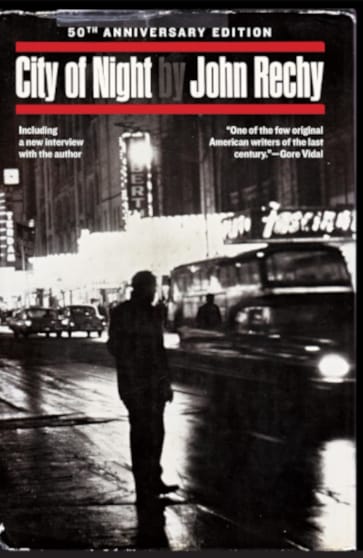
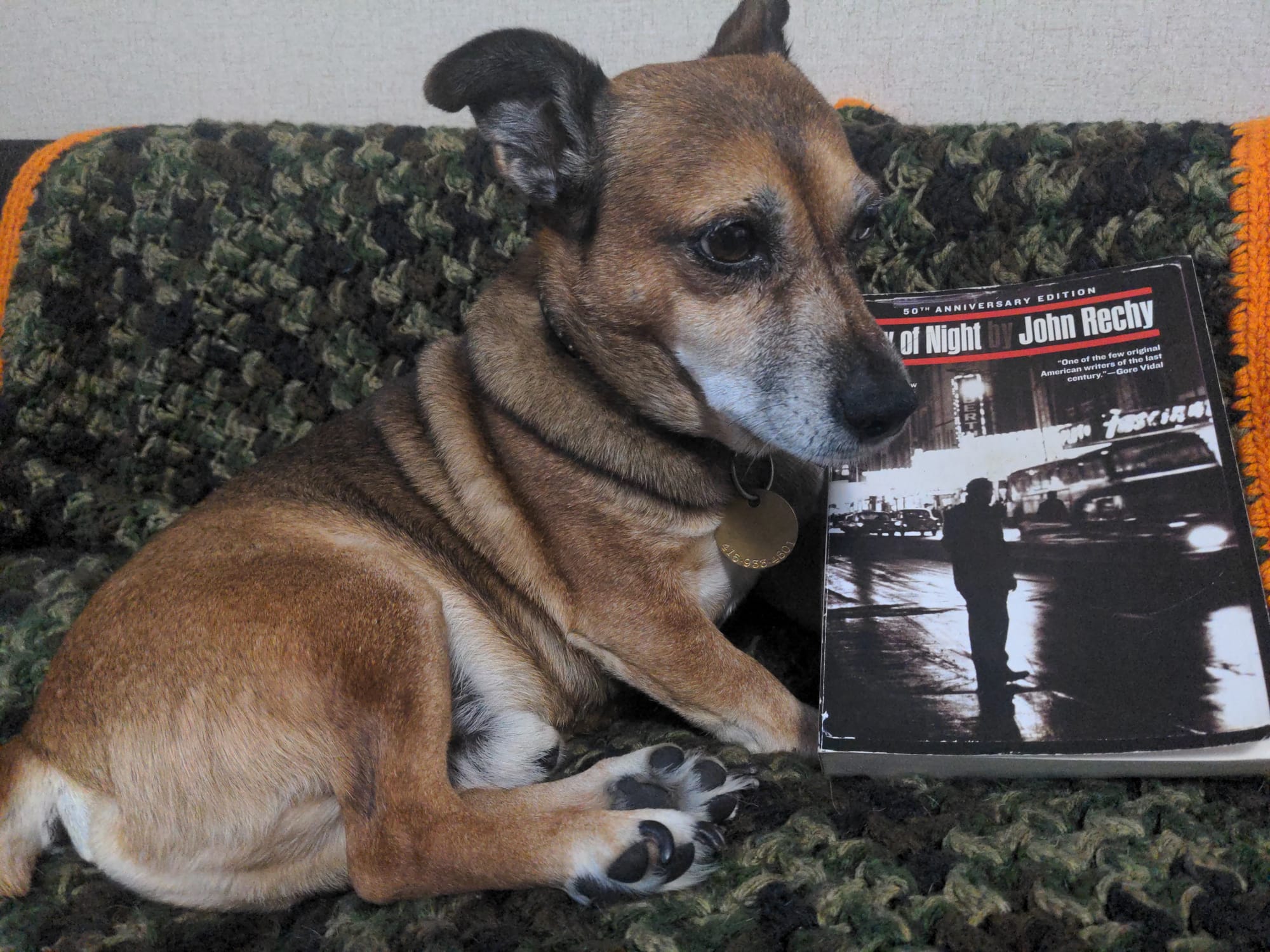
I am curious to read some old transsexual literature for this newsletter, but I cannot think about old transsexual literature by only reading books by trans people, because that is simply not how it goes. The transsexual world is made up of hustlers, faggots, and dykes, crossdressers and bisexuals, incarcerated people, and many freaks who defy identity categories. We are all stronger together. While reading Balagoon, I also picked up John Rechy’s classic City of Night, a book that is not by a transsexual but that manages to include some wonderful transsexuality in it. Queens on every other page, romances between butch dykes and fairies in the background, it’s a true kaleidoscope of gay genders, although it is the confrontations with the police state that had me recalling the novel.
City of Night was published in 1963 and chronicles Rechy’s own (barely fictionalized) adventures in the gay underground during the fifties, a decade that saw entrenched amerikan fascism in the House Un-American Activities Committee and Jim Crow. Likewise, this is a time of heavy surveillance and criminalization of homosexuality and gender variance, and also an era of forgotten and smaller Stonewalls, individual and community rebellions against police. Rechy travels widely, from Texas to New York City, California, Chicago, New Orleans, and finds his way in the “malehustling and queen” worlds, chronicling them in his distinctively lyric, rhythmic prose. At heart, it is a book about yearning and living under a hostile state.
“This cop—this Sergeant Morgan. Man—he routs me once, takes me downstairs—where they interrogate you. We’re alone—tries to put the make on me—I slug him. Man! A cop! But, hell—dig: hes scared shitless—scared Im gonna tell on him. He lets me go—tells me if I ever show, he’ll bust me—…” He holds his glass in both hands, squeezing it tightly. “Motherfuckers,” he says, shaking his head, as if he were passing judgment on all people crammed into his life.
That’s the character Skipper in a long scene ruminating on his life as an aging hustler. The novel is a series of portraits and characters, and everyone we meet has their own way of navigating the rules of the surveillance state. Rechy notes subtleties of dress, strategies for moving in public, but characters are still constantly fleeing, running from danger. Whatever ways they resist, however, they are all well aware of the specific rules and authoritarian figures they live under, and they pass this knowledge to each other.
Once, weeks before, sitting with him at Hooper’s coffee-and-donuts after two in the morning, we had been picked up at random from the other faces there by two cops. Chuck had remained lackadaisically cool, almost Philosophical. He told me: “Shoot, unless they really want you for something, we will be back here in jes a few minutes. On weekends, man, this late, they got too many in the joint already….But we gonna take a little trip to the glasshouse,” he predicted—and he was right—the glasshouse being where they interrogate you, fingerprint you without booking you: an illegal L.A. Cop-tactic to scare you from hanging around...
Today, a part of the great danger we face comes from the fact that the rules have changed, but we don’t quite know how. We are hit daily with a spectacle of ugly threats, megaphones that declare ultimate power. These threats and declarations are mostly hollow, but even when the bark has no bite, the enforcers of fascism, official and self-appointed, understand that they have been given permission to indulge their worst impulses. They understand that they can be rewarded for violence and for defying norms, and they act accordingly. This makes the work of living more perilous, no longer knowing where we stand. Intentionally, the chaos of this time also makes it more difficult to take action against the authoritarians.
The confusion has been on my mind as we watch the Trumpists launch a complete assault on trans life, activating the apparatus of the post 9-11 surveillance state to do so. This intensified sharply in the wake of the recent Utah assassination, which the right blamed on transsexuals and “antifa,” two amorphous groups. Many now believe the onslaught of mass shootings and atrocities that are the norm in this country are a result of more transgender people accessing hormones. Like always, the hypocrisy is extreme– for over thirty years now we’ve been subjected to a seemingly endless succession of mass shooters who are white, right-wing boys and men. But the fascists will claim whatever reality they want, and will use the hatred they stir to justify anything and everything. So we get the Kirk hagiography, the censoring of network television, a slew of firings for protected speech, and desperate, blustery proclamations that trans people are terrorists. As a result, and with so much else occurring at the same time, the reality of the threats we live under becomes increasingly difficult to discern.
A recent shooting in Minnesota is one of the very few that actually was carried about by a trans person or detransitioned person. More important than the gender identity, however, is that the shooter exhibited clear signs of influence from the stew of Nazi death cults that fester online. The most prominent of these cults is The Com, a disorganized network of Neo-Nazi abusers and terrorists who target children, and which is one of the most horrifying nightmares to come out of our time, in my opinion. As this group is growing, and knowing they like to target trans people, we might expect to see more of this. The Minnesota shooter expressed allegiance not with The Com specifically, but with the broader culture of mass shooters, fascist hate, and terror that these groups promote in online forums. The high-profile shooter in Utah similarly expressed a deeply online nihilism and vile irony that is cultivated in male gamer worlds. Focusing blame on trans people prevents us from learning the truth about these attacks and potentially doing something about the problems that lead to more of them. And of course the people blaming transsexuals know all of this and happily run cover for the Nazis.
What a ghoulish fascism from Trump! These people are as vile and low as you can go. And of course trans people remain defiant and strong in the face of it, with Gretchen Felker-Martin demonstrating for us the power of free speech while so many others cower.
The longest confrontation with fascism in Rechy’s novel comes not with a cop, but a Nazi, woman-hating leather daddy who fetishizes and collects authoritarian uniforms—the most grotesque figure in the book. The narrator is overcome with loathing and disgust for this man, and his internal turmoil reaches its crescendo when he wants nothing more than to beat the pathetic fascist, indulge in violence, yet becomes also aware that this will give the masochistic man exactly what he wants.
...and disassociating myself from all feelings of pity and compassion, to which—despite the compulsive determination to stamp out all innocence within me and thereby to meet the world in its own savage terms; to leave behind that lulling, esoteric, life-shuttering childhood, that once-cherished place by the window—to which, despite all those things, I had, I know, still clung: to compassion, to pity...
The narrator smashes the fascist with his boot, after which he is struck by “...a maelstrom of revulsion—for myself, for him, loathing for him…” He then offers compassion despite himself, reaching out a hand, which only disgusts the costumed man. The narrator’s own revulsion is not a rejection of violence. Soon after, a burly queen named Chi-Chi slugs a man who disrespects her on the street, and she becomes almost saintly for it in the narrator’s memories. Instead, he is revolted that he has sunk to the level of the miserable fetishist, let the sniveling Nazi define their engagement—that because of this he has become in some way monstrous himself and in turn has validated the man he stomps on.
City of Night is a struggle against loneliness in a fucked world. Human connection, fleeting and impossible, is still sought. That is one of the lessons I am taking away today, while obscene authoritarian spectacles play out on the national stage. Whatever ways we resist and fight in the dire months ahead, we have to fight first for our hearts and our souls, for our full humanity and the humanity of everyone, neighbor and stranger. The weak and easily defeated Trumpists try to fashion themselves as gods and kings, but we do not have to play their games. We can make our own ways, like we always have.
Sandi, the woman from the trans elder storytelling event, spent most of her talk telling us about her experience as a social worker in New York City during the eighties and nineties. When, at the start of her career, her boss informed her that she should not come to work dressed as a woman, she filed an official complaint. Over the following decades, she managed to build a career and advance in family protective services despite constant discrimination and attempts to fire her. She insisted always on her rights and fought for them. This, also, is remarkable, a sustained act of resistance during a time when working as a transsexual was supposedly impossible, discrimination legal.
Now, like always, each of us must pick from many paths forward. I was glad to watch this month Zackary Drucker’s recent documentary Enigma, which tells two entwined stories, those of April Ashley and Amanda Lear. Both women worked in the fifties at Le Carrousel de Paris, the famous and ritzy Parisian cabaret that featured transsexuals and queens. Ashley went on to become a famous model before she was outed against her will and lost that career. She then married a British aristocrat (later Duke), and when he attempted to annul their marriage on the grounds of her being transgender rather than pay her what was due in a divorce, the court case became a major inflection point for trans rights in the UK. Ashley, in losing the case, faced incredible personal difficulties and loss. She also emerged as a trailblazer and hero of the struggle for trans liberation, campaigning for decades until the ruling was finally overruled. Lear, choosing a more closeted path, became one of the most famous disco artists of her generation, a muse of Salvador Dali, and a lauded public figure. Throughout her career, she has sometimes teased the fact of her transness while always also denying it. Drucker notes her 2001 synth pop album, “I’m a Mistery,” as one of many examples.
Lear remains a celebrated, glamorous public figure. Throughout her long interview with Drucker, she steadfastly refuses to acknowledge that she is trans. Toward the end of the movie, however, Drucker gracefully and generously finds a way to bring an implicit, subtle acknowledgment about. In an electric, tense scene, she talks about the incredible contribution Lear has made to trans culture, what an icon she is to so many girls, and how difficult it must have been decades ago. And Lear, finally, comes as close as she will to talking about it. "It's easier, I suppose, for the girls now, today. For the new generation," she says. "Things have become a little easier."
It is beautiful when we find our humanity together. Like Chi-Chi, brazen and bold in her lace dress, who steps out of the bar and shouts to the street, “Hey, world!”
&:
John Rechy is still with us, as is Roz Kaveney, Pat Califia, Amanda Lear, and so many others. Truly, the times I am revisiting through books are not gone—we are still in their time.
Most of the trans prison writing I know has been published by independent projects that focus specifically on trans prison writing. There is a good deal of this work, and much of it is circulated primarily to other incarcerated trans people. I am, as always, eager to read more published works of trans prison writing—please email me with your favorites.
Personally, I’m a wimp when it comes to running afoul of the state. I try not to let this stop me, as I understand it is a moral imperative to be brave and not allow the fascists to set the terms of engagement. Still, my hands shake when I wheatpaste my little posters to telephone polls, and my anxiety spikes whenever the cops are around regardless of what I am doing. The feeling reminds me of being a teenager in the nineties, pulse racing as I dared myself to wear a few more brightly colored jelly bracelets to school, or to leave one fingernail painted after the punk show. Knowing I could be beaten for this, but still yearning to declare my gay love of ska!
Always, I only regret not going further.
Will this newsletter just be rhapsodizing about gay bars? With Merrill Mushroom’s Bar Dykes in mind, and a Vaginal Davis show about to open in New York, there’s surely more to come.