Sycamore, Rojava, Assimilation

As MAGA crumbles, the time is now!
War spreads, and I have been looking to the autonomous region of Rojava and the free people there. For well over a decade, the revolution in Rojava has held the line against authoritarians and religious fundamentalists. Under siege from all sides, the nearly five million people who live there have created a collective experiment in face-to-face democracy with core values of gender equality, environmentalism, and religious and ethnic diversity. After playing a pivotal role in defeating ISIL, Rojava has been abandoned by temporary allies from the United States and now faces a wave of attacks and existential threats from the new Syrian government and the Turkish state. I have been grateful for the independent and anarchist journalists who have written from the autonomous region these last few months, and to see people organizing globally for Rojava. Here’s a great place to learn more if you aren’t familiar.
Here under the Trump regime, too, something like a revolution builds. More people than ever are sympathetic to the truth. The last decade of uprisings, campus protests, and mutual aid work has led to new and renewed organizing and powerful acts of resistance, with small groups bearing whistles and snowballs regularly chasing away the secret police. In so many ways, people are taking action and winning. I have never seen anything like this, and I am heartened at this dire time, and as we must now confront the empire as it attacks the people of Iran.
We are more than twenty years into the war on terror, but the conditions are very different from 2003.
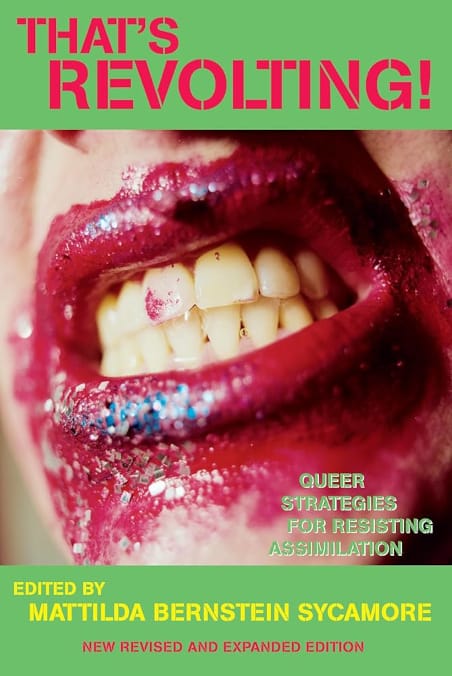
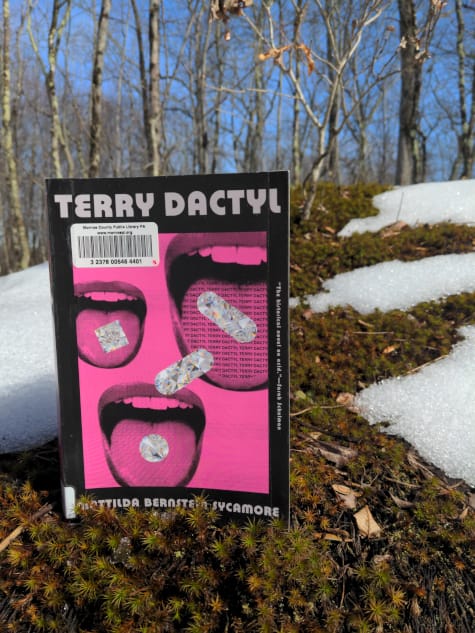
Meanwhile, as the right collapses and lashes out with violence, I see from the establishment only more reformist capitulation, craven attempts to shore up institutions and their own positions rather than meaningfully respond to the demands of the people. We have to battle these establishment figures as we also battle the fascists, understand them as two pillars of power in the same corrupt system. This familiar push to assimilate radical movements was on my mind when I picked up Mattilda Bernstein Sycamore’s sharp and fun latest novel, Terry Dactyl, and it had me turning also to her seminal 2005 anthology That’s Revolting: Queer Strategies for Resisting Assimilation.
That’s Revolting features a broad range of voices from the gay and trans political underground, active mostly from the seventies to the early aughts. In interviews and essays, they chronicle successes and failures from gay movements that actively resisted assimilation and fought to continue revolutionary practices in art, life, and direct action. I first encountered the book in Kalamazoo, Michigan, shortly after it came out, when I was in a college twink triad and one of the twinks learned about it from his cool dyke gender studies professor. I remember the anthology being incredibly clarifying in helping me to understand that particular changing moment in gay life, and I know others who had a foundational experience with it, too.
Jim Eigo: Well, it starts in a very small way. And with ACT UP, it just really started with a handful of people who sat down at Wall Street. But ACT UP snowballed awfully quickly, and when word got around that on Monday night ACT UP gave a home to people who were sick, people who were not yet sick, and to their friends and people who cared for them, it was not long before a hundred to two hundred people were meeting in that room every Monday night. Pretty soon, it would be four hundred and even more… everyone who was active in ACT UP wound up drawing on resources they had inside them, that they never dreamed they had– just never dreamed they had. But it only could have come out of them because they were locking arms with a hundred other people, at that point. I’ve always believed in community, and ACT UP is the most splendid enactment—during those two or three years of its height—it’s the most splendid enactment of the idea of community I’ve ever been a part of.
Along with the revolutionary potential of queer life, there has always been an assimilationist current. Mattachine, who had a fetish for legality, famously put up a large sign after Stonewall, “We homosexuals plead with our people to please help maintain peaceful and quiet conduct on the streets of the Village.” But starting in the nineties and moving through the present day, a particular tidal wave of assimilation crashed into gay and trans life. Decades of work from the underground had made meaningful changes to some conditions aboveground, and as the impacts of the AIDS crisis played out, there emerged for the first time a significant “pro-gay” establishment within mainstream culture and politics, aligned with some gay and lesbian people who could now move openly in those spaces.
When I entered queer culture around 2001, the fight against this emerging gay mainstream was one of the core political frameworks I found. This meant understanding queerness as being in direct opposition to the state, the military, prisons. From the revolutionary lessons of ACTUP, Transgender Nation, and other groups, the radical potential of queer and trans cultures was being co-opted by Democrats and corporate media and funneled into empire and the spreading war on terror, and this was confronted as a crisis.
Even as the state shifts strategy from assimilation to outright eradication, the crisis in That’s Revolting is the same we face today, sometimes literally. There are quite a few pieces in the anthology where gay and trans people organize specifically against Gavin Newsom. The iconic Tommi Avicolli Mecca refers to him as “an ambitious supervisor,” “a so-called pretty-boy type who grew up with a silver spoon in his mouth and wanted desperately to be mayor.” And like in today’s gay and trans political life, throughout the anthology the fight for Palestine takes central focus. Alongside its relevance, the book is also rich with surprises. I was delighted, for example, to learn a little more about how the Weather Underground mandated homosexuality for everyone.
That comes from my favorite piece, a conversation between Ed Mead and Bo Brown of the George Jackson Brigade. Here is more from Ed Mead.
I’d had a few homosexual experiences in the course of my life, but I always identified as heterosexual. I wobbled back and forth over the spectrum between homosexual and heterosexual. Bo’s the one who turned me out [laughs]. On a trip down to Oregon together we had a long talk. I got the idea from her that men in the Brigade—and men in the movement in general—needed to be looking to each other to meet their emotional and sexual needs. Only then would we stop draining women’s energies so that women could develop their own strength and abilities.
We started implementing those changes within the Brigade, but where it really came to fruition was at the Washington State Penitentiary at Walla Walla in the development of Men Against Sexism, which confronted prisoner-on-prisoner rape, the buying and selling of prisoners. I identified myself as a “political faggot”: someone who has sexual relationships with men, not necessarily because I lusted after them, but because it was the correct thing to do. At the time, I considered this something which would help my development and help the development of other people in the group. In essence, the idea was that, as a male, you couldn’t call yourself anti-sexist unless you had sucked a dick.
Truly, the world is what we make it, limited only by our imaginations.
Fascism works hard to assimilate queerness in its own ways. Nick Fuentes, the ascendant Nazi, is a virgin catboy lover who proudly proclaims that the reason he’s never had sex is because he hates women so much. A year ago, the celebrity Navy Seal who (maybe) shot bin Laden posted on Twitter to comment on a carload of twink Kamala Harris voters, “You’re not men. You’re boys. If there was no social media, you would be my concubines.” When people tried to tell him what “concubine” meant, he made a video to defend himself where he called them betas, repeated that they would be his concubines, and stressed that he’d do whatever he wanted to them. The gender systems of our world evolve again, more rapidly each time, and like true fascists, GI Joe and the Nazi dweeb offer a reactionary masculinity in response, twink sex slaves for straight men. A neoclassic gender!
Moving though this nightmarish world, I am grateful for gay and trans writers like Mattilda, artists who put out work for decades and take gay life seriously in the whole mess. Terry Dactyl is one of those books. In Mattilda’s lyric gay wit, the story follows a trans dyke who grows up in a dyke family in Seattle, living through the onset of the AIDS crisis before moving to New York City to become a club kid and work at an art gallery. The second part of the novel features Terry returning to Seattle during the onset of Covid and discovering how her family and friends from a radical past move through the Trump era. The character despairs at everyone’s interior design, and it’s quite beautiful and sometimes tragic to see the relationships enduring (or not), changing, reviving over time. A dear old friend lands in a fancy corporate job at Amazon, and she and Terry quip back and forth on their different lives, loving and familiar. A Covid-era group reunion call breaks down into a yelling fight about someone who died decades ago, and the dyke moms are revealed to be old community friends with Seattle’s lesbian mayor, a pro-cop disaster. And all the while, Terry finds life and freedom in public spaces, political uprisings, and small acts of vandalism, both alone and with friends.
Marya always said if you smash a window never look back or they’ll know it’s you, so I don’t look back but I feel like everyone’s looking at the hammer sticking out of my pocket even though no one’s looking at me at all, and when I turn on Thomas I see that towering cedar, I step up on the roots and think yes, we’re in this together, touching the bark as I’m walking up the hill but my heart is still racing when I turn onto Harvard, get to my building and rush up the stairs and when I’m finally back in my apartment I’m laughing, yes, I’m laughing, Terry, yes, we did it.
This burst of freedom is such an important part of taking action. It is what queer anti-assimilation is really all about, refusing in whatever way you can and feeling good. I remember how Claude Cahun and Marcel Moore wrote of this life-giving joy while operating their anti-Nazi propaganda campaign under occupation. Even a very small action against the state can hurtle you into the revolutionary spirit.
And there’s no reason this moment can’t be revolutionary. In fact, it has to be!
&c
The visits to the autonomous zone in Seattle’s Capitol Hill were a nice treat in Terry Dactyl. To hold a space even temporarily as an autonomous zone is such a thrill, and there is incredible power in it. In addition to Rojava, I have been in awe to see the anarchists in Exarcheia, Greece, endure over decades of repeated threats. And once again, it is thanks to self-organizing anarchist journalists and writers that I know what’s happening!